UNESCO’s 2026 Gender Report finds that only 59 girls complete upper-secondary education for every 100 boys in rural India, highlighting persistent educational inequalities.
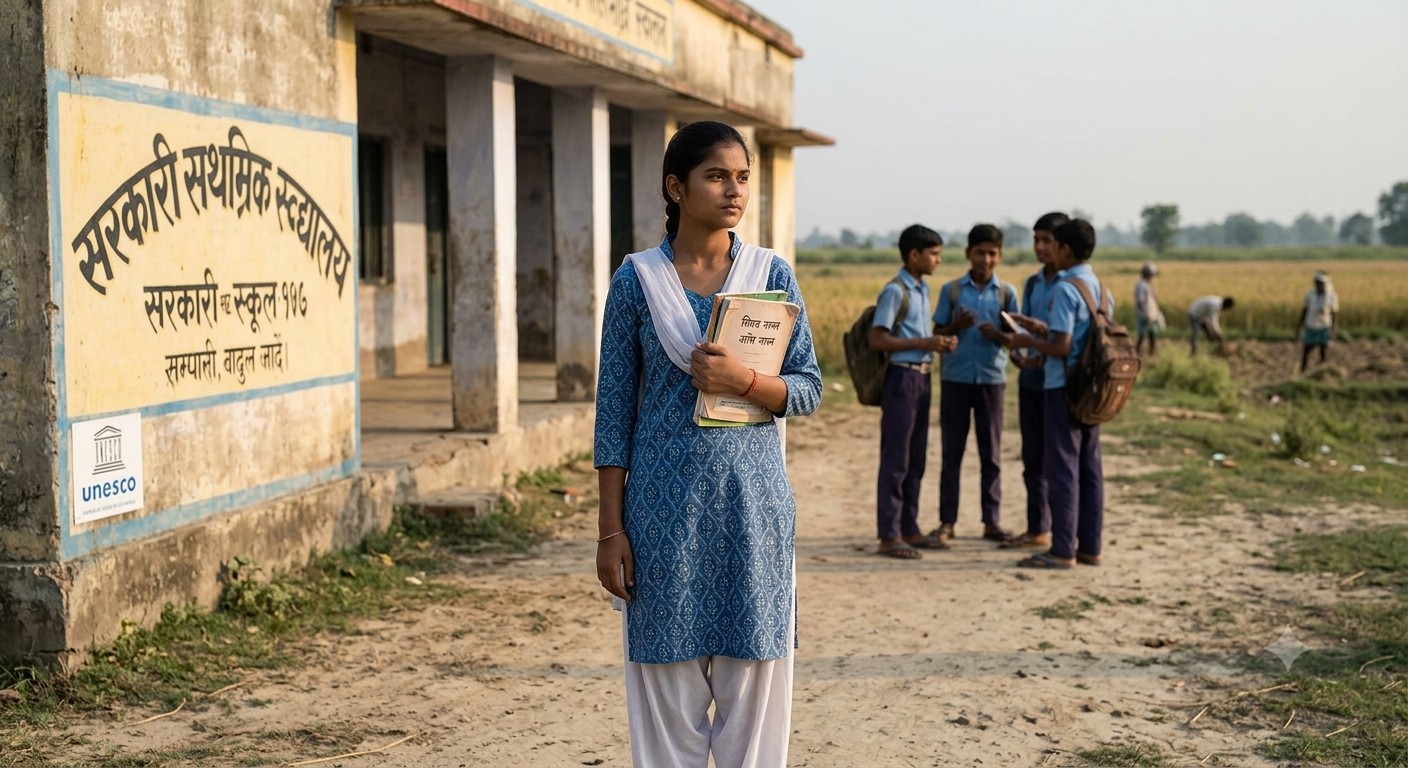
India has achieved gender parity in upper-secondary school completion in urban areas, but a substantial gap persists in rural communities, where only 59 girls complete this level of education for every 100 boys, according to a new report by the United Nations Educational, Scientific and Cultural Organization (UNESCO).
The finding is part of UNESCO’s 2026 Gender Report, Gender Equity in Access to Education, released around the International Day of the Girl Child on October 11. The report highlights how global progress in girls’ education can conceal inequalities shaped by poverty, geographical location, early marriage and pregnancy.
While gender gaps in school enrolment have narrowed significantly worldwide, UNESCO warns that getting girls into school does not necessarily mean they will complete their education.
The report’s findings point to a continuing challenge for India: ensuring that girls, particularly those from rural and economically disadvantaged households, can remain in education through the higher secondary years.
Enrolment gains do not guarantee completion
Globally, gender parity in enrolment had been achieved by 2024 from pre-primary through upper-secondary education, according to UNESCO. This represents significant progress in girls’ access to formal schooling.
However, enrolment and completion measure different stages of educational participation. A girl may enter school but leave before completing secondary education because of financial pressures, household responsibilities, social expectations or difficulties accessing a suitable school.
UNESCO’s data shows why national and global averages must be examined alongside differences within countries.
In India, urban areas have reached parity between girls and boys in upper-secondary completion, while the rural ratio remains substantially lower. The report does not attribute the entire rural gap to any single cause, but it identifies poverty, location and gender-related barriers as factors that can shape educational opportunities.
For rural girls, continuing education may depend not only on whether a school is available but also on the affordability of transport, the safety of the journey, family resources and the expectations placed on them as they grow older.
Early marriage and pregnancy remain barriers
UNESCO’s report identifies child marriage and early pregnancy as continuing obstacles to girls completing their education.
The proportion of girls worldwide who married before turning 18 declined from 25% in 2000 to 18% in 2025. Despite this progress, the figure remains at 25% in Central and Southern Asia and 31% in sub-Saharan Africa.
These regional figures underline the continuing scale of child marriage, although they should not be interpreted as India-specific estimates.
Marriage and motherhood can interrupt education when girls are expected to take on domestic work, caregiving or other responsibilities. Pregnancy may also expose adolescents to stigma or exclusion, while young mothers can face practical difficulties returning to school.
UNESCO cited an estimated six million pregnant girls and young mothers aged 10–19 who were out of school in sub-Saharan Africa in 2024. Fewer than 5% of pregnant and parenting girls in the region returned to education, according to the report.
These figures relate to sub-Saharan Africa, not India, but they demonstrate how difficult it can be for girls to resume education after pregnancy when schools and support systems do not accommodate their circumstances.
Legal rights need practical support
Policies permitting pregnant girls and young mothers to continue or resume education are an important step, but UNESCO warns that formal rights alone may not be sufficient.
Girls may struggle to return to school because their families cannot afford transport, childcare is unavailable, sanitation facilities are inadequate or they face stigma from classmates and communities.
The report says that, in 2026, 58% of countries guaranteed the right to education without discrimination based on sex or gender in their legal frameworks. Only 35% explicitly protected the right to education of pregnant and parenting girls.
The figures reveal a gap between broad commitments to educational equality and explicit legal safeguards for girls whose education is disrupted by pregnancy or motherhood.
UNESCO also points to measures that can improve access, including financial assistance for disadvantaged students, safe transport, adequate sanitation, protection from violence and flexible routes back into education.
Evidence cited in the report suggests that interventions can make a measurable difference. In Burkina Faso, building schools designed to better meet girls’ needs increased enrolment by 19 percentage points overall, with larger gains for girls.
Poverty and geography shape girls’ opportunities
The report cautions against treating gender equality in education as a problem that has been solved simply because enrolment figures have improved.
Differences in household income and location can produce sharply unequal outcomes even within the same country. UNESCO cites Angola as an example: among its least privileged households, only 30 girls completed upper-secondary education for every 100 boys, while gender parity had been achieved among the richest households.
India’s rural-urban divide similarly highlights the need to examine which groups of girls are being left behind.
Improving educational access requires more than increasing school enrolment. Governments and education authorities also need to identify where girls are dropping out, whether they can afford to continue, and whether schools provide safe and supportive environments.
UNESCO recommends combining free and compulsory education with targeted financial support, measures to prevent child marriage, support for pregnant and parenting learners, safe transport and flexible pathways that allow students to return to education.
It also calls for educational outcomes to be monitored by gender, household wealth and location so that national progress does not conceal persistent disadvantages among particular groups.
The challenge beyond school enrolment
The report arrives as governments and international organisations mark the International Day of the Girl Child, observed annually on October 11.
Its central message is that progress in access to education must be matched by progress in completion and equal opportunity.
For India, the rural disparity highlighted by UNESCO raises questions about whether girls can continue their education through the years when family responsibilities, financial constraints and social expectations may become more influential.
The data does not establish that every rural girl faces the same barriers, nor does it identify a single explanation for the completion gap. It does, however, point to a substantial difference in outcomes that requires closer examination.
Closing that gap will require education policies that look beyond enrolment figures and address the circumstances that determine whether girls can stay in school, complete their studies and pursue opportunities beyond the classroom.
Source: UNESCO, 2026 Gender Report: Gender Equity in Access to Education, and its report announcement published on October 8, 2026.
Read the original report: https://www.unesco.org/en/articles/gender-gaps-education-narrow-globally-yet-early-marriage-remains-major-barrier-girls-education-new
Explore the full report: https://www.unesco.org/gem-report/en/publication/2026-gender-report