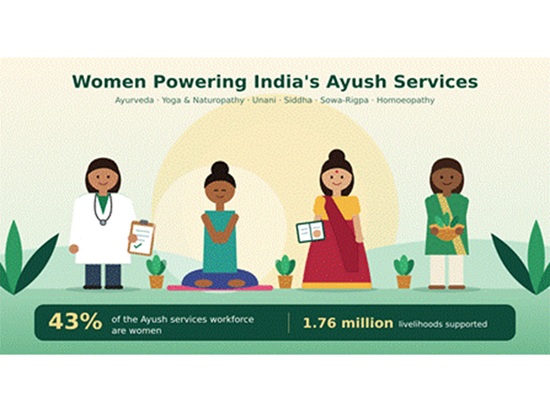
Women make up 43% of India’s AYUSH workforce, with female representation crossing 50% in hospitals, wellness centres, day-care facilities and education.
India’s growing AYUSH economy is emerging as an important employment avenue for women, with women accounting for 43 per cent of the sector’s overall workforce and making up more than half of employees in several organised segments, according to a recent assessment.
The numbers are particularly striking in healthcare, education and wellness establishments, where women’s representation is considerably higher than the sector-wide average.
Women account for 53 per cent of the workforce in AYUSH hospitals, 57 per cent in day-care centres, 58 per cent in educational institutes and more than 60 per cent in spas and wellness resorts, according to the Ayush Service Sector Report, a study by the Research and Information System for Developing Countries (RIS) released during Ayurveda Day 2026.
The findings offer a different way of looking at India’s expanding traditional medicine economy: not just as a healthcare sector, but as a growing source of work and livelihood for women.
A $36.92-billion sector
The AYUSH services economy — covering Ayurveda, Yoga and Naturopathy, Unani, Siddha, Sowa-Rigpa and Homoeopathy — was estimated at US$36.92 billion in FY2024-25.
The sector has recorded a 16.91 per cent compound annual growth rate (CAGR) since FY2022-23 and is estimated to directly support around 1.76 million livelihoods across healthcare, wellness, education and allied services.
That footprint extends far beyond large hospitals.
More than one million livelihoods are concentrated in local and standalone clinics, making these establishments an important part of the sector’s employment landscape in both urban and rural areas.
For women, the growing organised segment may be particularly significant because employment opportunities are spread across several types of work — from healthcare delivery and teaching to wellness services and other allied occupations.
Where women’s presence is strongest
The strongest female representation is visible in wellness and organised healthcare.
According to the assessment:
- Spas and wellness resorts: more than 60% women
- Educational institutes: 58%
- Day-care centres: 57%
- Hospitals: 53%
- Overall AYUSH services workforce: 43%
The figures suggest that women are not confined to a single occupational corner of the AYUSH economy. Their participation cuts across clinical services, education, wellness and institutional employment.
That distinction matters.
A growing sector does not automatically translate into better opportunities for women. The quality, stability and organisation of jobs determine whether economic growth actually expands women’s economic participation.
The report’s findings indicate that organised AYUSH establishments are already seeing relatively high levels of female participation.
Wellness is growing — and so is the opportunity
The wellness segment is among the fastest-growing parts of the AYUSH economy, recording a 21.29 per cent CAGR.
Yoga centres alone registered around 75 per cent revenue growth over two years, reflecting increasing demand for preventive healthcare and wellness services.
This growth could create opportunities beyond conventional healthcare roles, including wellness services, teaching, therapy, administration and other support functions.
For women seeking employment in the expanding health and wellness economy, this makes AYUSH an area worth watching — particularly as demand shifts towards preventive health and holistic wellbeing.
Ayurveda remains the biggest piece of the pie
Among the different AYUSH systems, Ayurveda remains the largest, generating an estimated US$17.73 billion, or roughly 48 per cent of total AYUSH services revenue.
Standalone clinics are the largest revenue-generating segment, contributing an estimated US$16.21 billion, or 43.9 per cent of the sector’s revenue.
Day-care centres contribute another US$10.13 billion.
Together, these two segments account for more than 70 per cent of the sector’s revenue, highlighting the importance of smaller and mid-sized healthcare establishments alongside larger institutions.
From local clinics to international patients
AYUSH is also becoming part of India’s growing medical value travel industry.
The sector generated an estimated US$1.77 billion from medical value travel in FY2024-25.
International patients account for only around 5 per cent of patient volumes, but they contribute an estimated 15–25 per cent of hospital-segment revenue. Therapeutic programmes involving international patients typically last between five and 11 days.
This creates another potential employment layer as the sector expands — particularly in hospitals, wellness centres, patient services, education and other allied areas.
What could this mean for women?
The significance of the numbers lies not only in the 43 per cent overall figure, but in where women’s participation is already crossing the 50 per cent mark.
Hospitals, educational institutes, day-care centres and wellness establishments are all organised spaces in which women constitute a majority of the workforce.
That could become increasingly important as the AYUSH economy expands.
The sector is projected to grow from US$36.92 billion in FY2024-25 to an estimated US$216–318 billion by 2047, according to the assessment.
Its future employment footprint is expected to span healthcare delivery, wellness, education, medical travel, research, digital health and allied services.
For women, that could mean opportunities across a much broader employment ecosystem than traditional clinical practice alone.
Union Minister of State for AYUSH Prataprao Jadhav said the sector’s expansion was creating employment opportunities across healthcare, wellness, education and allied services, while also opening avenues for entrepreneurship and skill development.
Secretary, Ministry of AYUSH, Vaidya Rajesh Kotecha, similarly highlighted the importance of skilling, quality standards, digital infrastructure and stronger institutional networks in expanding employment.
The bigger question: can growth become good work?
The AYUSH numbers tell an encouraging story about women’s participation — but they also raise a more important question.
Will the sector’s rapid growth translate into more secure, skilled and fairly paid work for women?
A 43 per cent female workforce share is significant. So is women’s majority presence in several organised segments. But workforce participation alone does not tell us about wages, leadership positions, job security, working conditions or the proportion of women in higher-paying roles.
Those are the numbers worth watching as the sector expands.
For now, however, one trend is clear: India’s AYUSH economy is not just becoming bigger. It is becoming a sector in which women already have a substantial presence — and in some of its fastest-growing organised segments, they are the majority.
Source: Ayush Service Sector Report, Research and Information System for Developing Countries (RIS), Ministry of AYUSH / ANI