Nearly one in four Gaza households is now headed by a woman. UN data reveal how war has reshaped family life, leaving women with greater burdens of income, care, displacement and safety.
Nearly one in four households in Gaza is now headed by a woman.
That means an estimated 86,290 households are currently headed by women — roughly twice the proportion recorded before the escalation of the war in October 2023, according to new data from UN Women. Before the war, women headed about one in nine households.
The number is more than a demographic statistic.
It is evidence of how war has altered the structure of families — and transferred an enormous burden of survival onto women.
Some of these women are widows. Others have husbands who are missing, detained, severely injured, forcibly disappeared or whose fate remains unknown. Some have effectively become the only adult responsible for finding food, securing shelter, caring for children and making decisions about how a family survives another day.
And they are doing this in a place where access to food, shelter, clean water, cash and essential services remains severely constrained.
For these households, the question is no longer simply what happens when a woman loses a family member in war.
It is:
What happens when she is suddenly responsible for an entire household in the middle of one of the world’s most prolonged humanitarian crises?
A dramatic shift in who heads Gaza’s households
UN Women’s September 2026 brief, Invisible No More: Left to Carry Households Alone, documents a profound change in household structures in Gaza.
Women now head nearly 24 per cent of households, compared with around 11 per cent before October 2023. The increase has occurred amid widespread killings and the disappearance or incapacitation of male household members.
But “women-headed household” can conceal several very different realities.
A woman may be a widow.
She may have a missing husband.
Her husband may be detained or severely injured.
She may have been separated from him through repeated displacement.
Or she may be carrying the household economically and practically even when another adult male family member is technically present.
The label therefore describes more than who is listed as the head of a family.
It increasingly describes who is carrying responsibility for survival.
And that responsibility has become exceptionally difficult in Gaza.
Women-headed households are facing worse shelter conditions
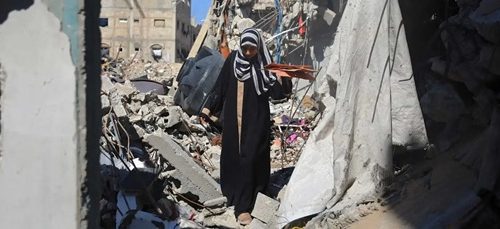
According to UN Women’s latest analysis, 68 per cent of women-headed households reported that their housing needs were not being met, compared with 55 per cent of male-headed households.
Their homes were also more likely to have been damaged or destroyed: 74 per cent compared with 67 per cent among male-headed households.
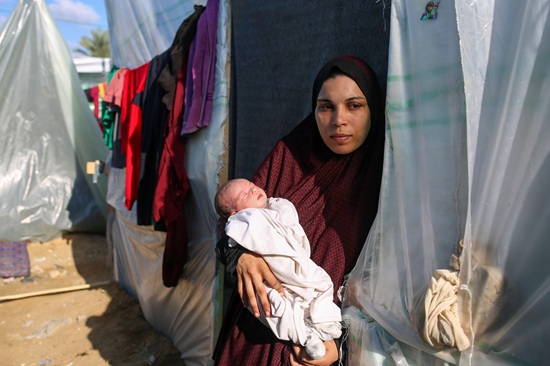
Women-headed households also reported being displaced an average of eight times since October 2023, compared with seven times for male-headed households.
One displacement can destroy a family’s belongings.
Repeated displacement can destroy its ability to rebuild a routine.
For women caring for children, each move can mean finding somewhere safe to sleep, locating water and food, protecting children from violence, replacing essential belongings and trying to maintain some form of income.
The repeated movement also creates another problem: every relocation can sever access to services.
A health facility may be left behind.
A school may no longer be reachable.
A community support network may disappear.
A woman who had found a source of income may have to start again.
And when the household is already headed by a woman, there may be no second adult income or caregiver to absorb that disruption.
The financial burden is becoming a survival issue
UN Women reports that 67 per cent of women-headed households urgently need cash for daily survival.
That figure matters because humanitarian assistance is not only about food.
Families need water, hygiene products, transport, healthcare, clothing, fuel and other essentials.
UNICEF’s recent monitoring of cash assistance in Gaza found that cash support remained a critical lifeline, serving as the main source of income or support for 72 per cent of assisted households in its June 2026 monitoring. More than 60 per cent of household expenditure was going towards non-food needs such as hygiene, healthcare, fuel, transport, clothing, communications, debt repayment and children’s needs.
For a woman responsible for children, these are not separate expenses.
They compete with one another.
A family may need medicine and food.
A child may need transport.
A woman may need hygiene supplies.
The family may need fuel.
There may simply not be enough money to meet everything.
This is where being the household’s primary decision-maker can become a series of impossible choices.
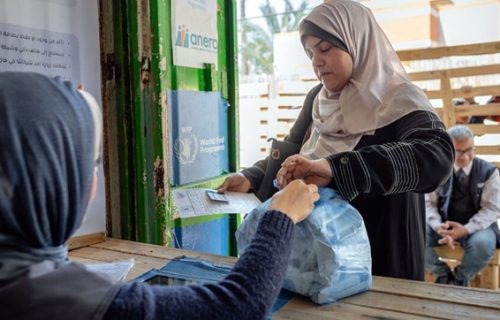
The aid queue can also leave women behind
There is another reason the new data matters.
Earlier in the Gaza crisis, UN Women found that humanitarian assistance was reaching only around one-fifth of recipients in some circumstances, with men disproportionately represented among those able to queue for assistance.
Gender data helped humanitarian partners identify and prioritise 14,716 women-headed households for food assistance.
The point is not that aid organisations were deliberately excluding women.
It is that a system designed around whoever can physically reach a distribution point can unintentionally favour people who have fewer barriers to doing so.
A woman caring for several children may not be able to stand in a queue for hours.
An older woman may not be able to travel safely.
A woman with a disability may face additional barriers.
A woman worried about harassment or violence may avoid certain locations.
A woman who has recently been displaced may not even know where the distribution point has moved.
Without gender-disaggregated information, these women can disappear from the statistics of aid recipients even while their households are among those facing the greatest need.
That is why the question of who receives assistance is inseparable from the question of who is counted.
War is also changing women’s unpaid work
The economic burden is only one part of the story.
Women-headed households are also carrying care responsibilities.
Children still need to be fed.
They need to be washed and protected.
They need emotional support.
They may need medical treatment.
They may have stopped attending school.
And many families have lost the extended family networks that previously shared these responsibilities.
The burden becomes especially difficult in overcrowded shelters.
UNFPA’s September 2026 analysis of gender-based violence in Gaza found that reported GBV incidents increased by 60 per cent in the first six months of 2026. The agency cautioned that this increase reflects both a deteriorating protection environment and expanded services that enabled more survivors to come forward.
Physical assault accounted for 31 per cent of reported incidents, while denial of food, cash, shelter and other assistance made up roughly one-third. Psychological and emotional violence also accounted for 31 per cent.
The reported cases occurred against a backdrop of overcrowding, displacement, inadequate shelter and scarcity.
For women heading households, the responsibility of protecting children therefore exists alongside their own protection concerns.
The safety problem does not end at the shelter door
UN Women’s latest data show that 19 per cent of women-headed households expressed concerns about their safety and protection, compared with 8 per cent of women living in male-headed households.
This difference is important.
A woman heading a household may have lost not only income and housing but also the social protection that previously came from a spouse or other family members.
That does not mean every woman living without a husband is automatically unsafe.
But in an environment of displacement, overcrowding and scarce resources, the loss of household members can create additional vulnerabilities.
UNFPA’s September report based on discussions with 230 women living in displacement camps in Gaza City and Khan Younis found that women described severe overcrowding, little privacy and limited access to food, clean water and functioning latrines.
These conditions can make ordinary daily life itself a protection challenge.
The health consequences are not separate from the economic ones
The same crisis is also affecting women’s health.
UNICEF’s 2026 SMART nutrition survey assessed women aged 15–49 alongside children under five in accessible areas of Gaza, examining maternal and child nutrition, illness, infant feeding and access to care. The survey provides a snapshot of nutritional conditions during its June 2026 collection period, rather than a picture of the entire Gaza population at all times.
That limitation is important.
In a rapidly changing conflict, no single survey can capture every household.
But the need for such surveys also demonstrates the problem: when routine systems are disrupted, even basic information about women’s health and nutrition becomes harder to collect.
For women heading households, health and economic pressures can reinforce one another.
A mother who is malnourished may struggle to care for children.
A woman without income may delay healthcare.
A family without adequate food may have to prioritise children over adults.
A woman repeatedly displaced may lose access to a familiar health provider.
And a household already struggling to obtain cash may have little ability to absorb an unexpected medical expense.
The story behind the number
Statistics can make the transformation sound abstract.
But behind 86,290 households are women making decisions under conditions that most families would find impossible.
UN Women has documented the experience of women who became de facto heads of households during the war.
One woman identified as S.A. described losing her home, moving repeatedly through displacement, losing financial support from her husband and struggling to provide for her three children. Her account was included in UN Women’s June 2026 reporting on how gender data were informing humanitarian assistance.
Her story illustrates why household statistics matter.
The number of women-headed households is not simply telling us that the composition of Gaza’s families has changed.
It is telling us that the people responsible for feeding, protecting and caring for children have changed.
That has consequences for humanitarian planning.
Women are not only recipients of aid
There is a danger in describing women-headed households only through vulnerability.
Women are also organising families, maintaining care networks, finding ways to earn, seeking services and helping communities survive.
UN Women says its humanitarian response in Gaza has increasingly worked through women-led organisations and local partners. Between October 2023 and December 2025, UN Women and partners reached nearly 196,000 people with protection information and services, emergency cash and livelihoods support and essential non-food items, including at least 165,000 women and girls.
That matters for the future as well.
If reconstruction eventually moves forward, women cannot be treated simply as people waiting to receive assistance.
They are members of households whose needs must shape recovery planning.
They are caregivers.
Workers.
Community organisers.
Survivors.
And, increasingly, the people responsible for entire families.
What happens after the emergency?
This may be the most important question raised by the new household data.
Wars eventually produce reconstruction plans.
Homes are rebuilt.
Businesses reopen.
Infrastructure is repaired.
But rebuilding a house does not automatically rebuild a household’s economic security.
A woman who has become a household head may need income.
She may need childcare.
She may need legal documentation.
She may need psychosocial support.
Her children may need education.
She may need protection from violence.
She may need access to financial services and employment.
And if her husband is missing or killed, the family may need legal and social support to resolve questions about property, inheritance, documentation and benefits.
These are not secondary concerns.
They determine whether a family can move from survival to recovery.
The data also changes what recovery should look like
The rise in women-headed households should therefore influence humanitarian and reconstruction priorities.
If nearly one in four households is headed by a woman, then programmes designed around the assumption that every family has an available male income earner will miss a substantial part of the population.
Aid systems need to identify women-headed households early.
Cash assistance needs to reach women directly where appropriate.
Shelter programmes need to consider safety and privacy.
Healthcare programmes need to account for women’s reproductive and maternal health needs.
Childcare and education support can reduce the unpaid care burden.
Livelihood programmes need to include women rather than assuming that household recovery will automatically restore their economic position.
And women-led organisations need a meaningful role in deciding how recovery resources are distributed.
UN Women has repeatedly argued that gender data can improve the targeting of humanitarian assistance. Its Gaza experience provides a concrete example: data about women-headed households helped identify families that might otherwise have been missed.
A household statistic is really a story about power
There is something deceptively simple about the phrase “women-headed household.”
It can sound like a demographic category.
But in Gaza, the rapid increase tells a much bigger story.
It reflects deaths, disappearances, injuries, displacement and the collapse of ordinary family structures.
It also tells us who is now expected to make decisions when resources are scarce.
Who finds the food?
Who protects the children?
Who searches for shelter?
Who decides which medical expense can wait?
Who carries the family when there is no income?
The answer is increasingly: women.
And that means the humanitarian response cannot treat women-headed households as a small subgroup.
They are becoming a significant part of Gaza’s social reality.
The number we should not lose sight of
The figure 86,290 can easily become another number in an already overwhelming stream of statistics about Gaza.
It should not.
Because each household represents a family structure changed by war.
It represents a woman who may now be responsible for children without the person who previously shared that responsibility.
It represents economic pressure, repeated displacement and protection concerns.
And it represents a challenge for humanitarian agencies and future reconstruction planners:
If women are increasingly carrying households, then women must also be at the centre of decisions about how those households recover.
The story of Gaza’s women-headed households is therefore not only about what war has taken from women.
It is about what the world does next.
Whether humanitarian systems see them early enough.
Whether aid reaches them directly.
Whether their economic survival becomes part of recovery planning.
Whether their safety is treated as essential.
And whether women themselves have a place in determining what rebuilding looks like.
The statistics show that Gaza’s households have changed.
The next question is whether the systems responding to Gaza will change with them.
Zenana Takeaway
The rise of women-headed households in Gaza is one of the clearest examples of how conflict can permanently alter the structure of family life.
When nearly one in four households is headed by a woman, women’s economic security, safety, healthcare and caregiving responsibilities cannot be treated as a side issue in humanitarian response or reconstruction.
The number is not just a measure of loss.
It is a measure of who is now carrying the burden of survival — and who must be included in decisions about recovery.
Sources
- UN Women, Invisible No More: Left to Carry Households Alone — War and the Rise of Women-Headed Households in Gaza, September 2026.
- United Nations in Palestine, In Gaza, women-headed households face ‘impossible choices’ to survive, September 9, 2026.
- UN Women, Gender data in Gaza are helping the humanitarian response reach women and girls, June 8, 2026.
- UN Women Data Hub, How gender data-informed UN Women support is helping women reclaim safety, dignity and leadership in wartime Gaza, June 19, 2026.
- UNFPA Palestine, GBV Trends Analysis April–June 2026, September 10, 2026.
- UNFPA Palestine, I Want to Feel Safe Again: Women’s Voices From Displacement Camps in Khan Younis and Gaza City, September 17, 2026.
- UNICEF State of Palestine, Gaza Strip Cash Assistance Monitoring, September 4, 2026.
- UNICEF State of Palestine, Gaza SMART Survey 2026, August 2026.