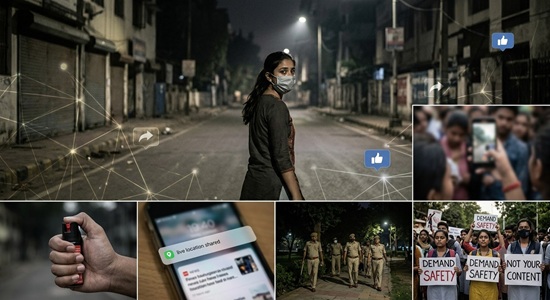
A week of sexual violence cases in India raises questions about public safety, victim privacy, social media, police response and what needs to change.
A sexual assault can end in minutes. For the woman who survives it, however, the consequences can continue through police stations, hospitals, court proceedings, social media and public scrutiny.
That reality has been particularly visible in India over the past week.
From a 17-year-old allegedly gang-raped in a South Delhi park to teenagers allegedly harassed in Bihar, a series of cases has renewed questions about the safety of women and girls in public spaces. In several of these incidents, videos circulated online, turning alleged violence into material consumed, shared and debated by thousands of people.
The result is a disturbing contradiction.
Technology can help expose a crime and identify suspects. The same technology can also expose the survivor.
And as outrage grows online, another question becomes increasingly difficult to avoid: what changes after the hashtags disappear?
A week that brought women’s safety back into focus
In South Delhi, a 17-year-old girl was allegedly gang-raped inside Aastha Kunj Park earlier this month. According to the FIR, three men allegedly posed as police officers, separated the teenager from her male friend and threatened them before the assault. Police subsequently arrested the three accused.
The physical setting of the alleged crime quickly became part of the public debate.
An investigation by The Indian Express found significant safety gaps at the 142-acre park, including a guard cabin without electricity, no CCTV cameras inside the park and several non-functional cameras at its gates.
Students from several Delhi University colleges subsequently protested, saying concerns about dark roads, inadequate patrolling and poorly functioning safety infrastructure had existed around their campuses for years. Students from Lady Shri Ram College, Gargi College, Miranda House and Kamala Nehru College participated in demonstrations and called for improvements to lighting, patrolling and other safety measures.
The issue has now reached the country’s highest court.
On September 28, the Supreme Court took suo motu cognisance of recent rape and sexual-assault cases in Delhi-NCR and raised concerns about public safety and law-enforcement failures.
The development is significant because it shifts the conversation beyond individual criminal cases towards the conditions that allow women and girls to remain vulnerable in public spaces.
In Bihar, the violence did not stay at the scene
The Jamui case has demonstrated another dimension of sexual violence in the digital age.
A video showing two teenagers being stopped and allegedly assaulted and harassed in Jamui began circulating widely on social media. Police subsequently arrested accused persons and pursued others in connection with the incident.
But the circulation of the footage created another problem: the identity of the minor survivor was reportedly exposed online.
Bihar Police launched action against social-media accounts that circulated material identifying the minor. Reports said police registered cases against around 120 URLs/accounts involved in disseminating the material.
The case therefore produced two very different uses of social media.
The footage helped bring the incident to public attention and assisted investigators.
At the same time, its circulation risked violating the privacy of the very person who had already been subjected to alleged violence.
That distinction matters.
A video of violence is not automatically evidence that the public has a right to watch, download or redistribute.
Another video, another girl, another public road
Days after the Jamui incident, a separate case emerged from Samastipur.
A girl was allegedly surrounded and harassed by a group of youths while travelling with a male acquaintance. A purported video of the incident showed the girl being held and pulled while she attempted to get away.
According to Samastipur police, the video came to their attention through social-media monitoring on September 23. Police said technical verification helped establish the location, following which four suspects were arrested. The girl was believed to be a minor, and police appealed to people not to circulate material that could reveal her identity or cause further harm.
Here again, social media played a double role.
It became a source of information for law enforcement.
It also became the means through which an alleged assault was reproduced for an audience that had nothing to do with the investigation.
That is a problem that cannot be solved simply by asking platforms to remove content.
It also requires users to stop treating footage of sexual violence as ordinary viral content.
When outrage becomes another form of exposure
There is an uncomfortable reality about the way sexual violence is discussed online.
A video appears.
People share it.
Accounts demand punishment.
Politicians comment.
Influencers react.
News organisations publish updates.
Thousands of strangers discuss the incident.
And somewhere within that enormous conversation is the person whose life has been permanently altered.
For survivors, public attention does not necessarily feel like justice.
Sometimes it can become another loss of control.
The survivor may have no control over who sees the footage, who saves it, who comments on it or how many times it resurfaces.
For a minor, the consequences can be even more serious.
India’s legal framework already places obligations on digital platforms concerning harmful and unlawful material involving children. The Union government said in July that the IT Rules require intermediaries to address content involving child sexual exploitation, non-consensual intimate imagery, impersonation and other harmful material, while also providing mechanisms for rapid removal of certain unlawful content.
The existence of those rules, however, does not automatically prevent harmful material from spreading.
That is where public behaviour becomes important.
The danger of turning allegations into verdicts
There is another lesson from this week’s events.
The speed at which information spreads online can be faster than the speed at which facts are established.
This was starkly visible at Lovely Professional University in Punjab, where protests erupted over an alleged sexual assault involving a female student. The protests later escalated into clashes, vandalism and vehicles being set on fire.
Police registered a case and constituted a Special Investigation Team. At the same time, the university denied that the alleged assault had occurred on campus and described the claims as false and baseless. Police said the allegation remained under investigation, with preliminary findings not establishing the incident at the location identified in the circulating claims.
The episode highlights an important principle for both journalists and social-media users:
Taking an allegation seriously and establishing what actually happened are not opposing responsibilities.
A sexual-assault allegation deserves a prompt and impartial investigation.
But an allegation is not the same thing as a conviction.
That distinction protects the integrity of the investigation while also protecting the public from misinformation.
Women should not have to live by a safety checklist
Every time a sexual-assault case becomes public, the conversation often turns towards what women should do differently.
Carry pepper spray.
Learn self-defence.
Don’t go out alone.
Don’t stay out late.
Share your live location.
Avoid isolated places.
Take a friend.
These precautions may help individuals navigate risk.
But they cannot become a substitute for public safety.
After the South Delhi incident, students described routinely sharing their live locations and looking for people to accompany them on journeys home. They also raised concerns about streetlights, police patrols, footpaths and emergency-response infrastructure around their colleges.
That raises a larger question:
How much responsibility can reasonably be placed on women to compensate for unsafe public infrastructure?
A well-lit road is not a privilege.
A functioning emergency response is not a favour.
A police patrol should not depend on a crime becoming nationally visible first.
Safety cannot begin after the crime
The South Delhi case has already prompted scrutiny of the physical environment in which women move.
The details are mundane but consequential: lighting, functioning CCTV cameras, patrols, accessible transport, emergency communication and people being able to report danger quickly.
These are not dramatic solutions.
But public safety is rarely created by dramatic solutions.
It is created by systems that work before something goes wrong.
The Supreme Court’s decision to take suo motu cognisance of recent Delhi-NCR cases brings precisely this institutional question into focus. The court’s intervention places attention on the responsibility of law-enforcement and public authorities to provide basic safety rather than leaving women to negotiate risk individually.
What needs to change?
The answer cannot be limited to harsher punishment after an assault.
Several layers need attention.
Public spaces need preventive safety measures
Authorities need regular audits of parks, roads, transport points and areas surrounding educational institutions.
That means checking whether streetlights actually work, whether CCTV cameras are functional, whether emergency points are accessible and whether police patrols cover locations identified by residents and students as vulnerable.
Victim privacy must be treated as part of justice
A survivor should not have to lose control of her identity after losing control over her physical safety.
This is particularly important when the survivor is a child.
People sharing videos, photographs, screenshots or identifying details should understand that “raising awareness” does not justify exposing a victim.
Social-media platforms need faster and more effective intervention
India has already strengthened its intermediary rules and introduced measures dealing with non-consensual intimate imagery and other harmful online material.
The challenge is ensuring that these protections work quickly enough in the real world, where a piece of content can reach thousands of people before a formal complaint is processed.
Police response must be visible before a crisis
Police monitoring of social media helped authorities identify the Samastipur incident, demonstrating that digital monitoring can contribute to investigations.
But technology should complement—not replace—ordinary policing.
Women should not need to wait for an assault to be recorded on someone’s phone before an unsafe location receives attention.
Newsrooms must report without creating another spectacle
There is a responsibility on journalists too.
A report should establish what is known, distinguish allegations from verified facts, protect survivors’ identities and avoid unnecessary descriptions that turn violence into voyeuristic material.
The question should always be:
Does this detail help the public understand the issue, or does it simply make the story more graphic?
If it is the latter, it probably does not belong in the report.
The real measure of safety
The most revealing part of this week’s incidents may not be the outrage they generated.
It may be what women were already doing before the outrage began.
Sharing live locations.
Avoiding dark roads.
Finding someone to accompany them.
Worrying about the last bus.
Checking whether a park is crowded.
Thinking twice before occupying public space after sunset.
These behaviours can become so normal that they stop being recognised as evidence of a safety problem.
But they are.
A city is not truly safe for women merely because a crime is investigated after it happens.
A university is not truly safe because an emergency committee is formed after a protest.
A digital platform is not safe because harmful content can eventually be removed.
And justice is not simply punishment for an accused person.
It also means protecting the survivor’s privacy, dignity and ability to continue living without becoming a permanent object of public consumption.
A woman should not need a viral video to make violence against her visible.
The real test of women’s safety is not how loudly society reacts after an assault.
It is how much protection, accountability and care exist before the next woman becomes a headline.