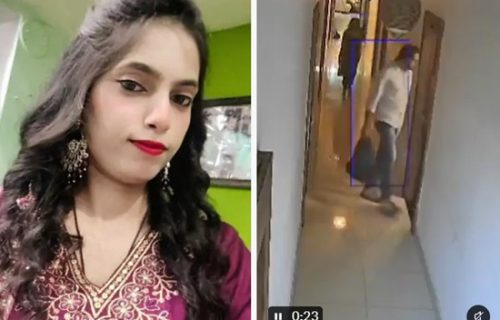
Kavita Mahato, a widowed mother from Jharkhand, ran 1,600 metres barefoot in a saree during a Home Guard recruitment trial as she seeks a more secure future.
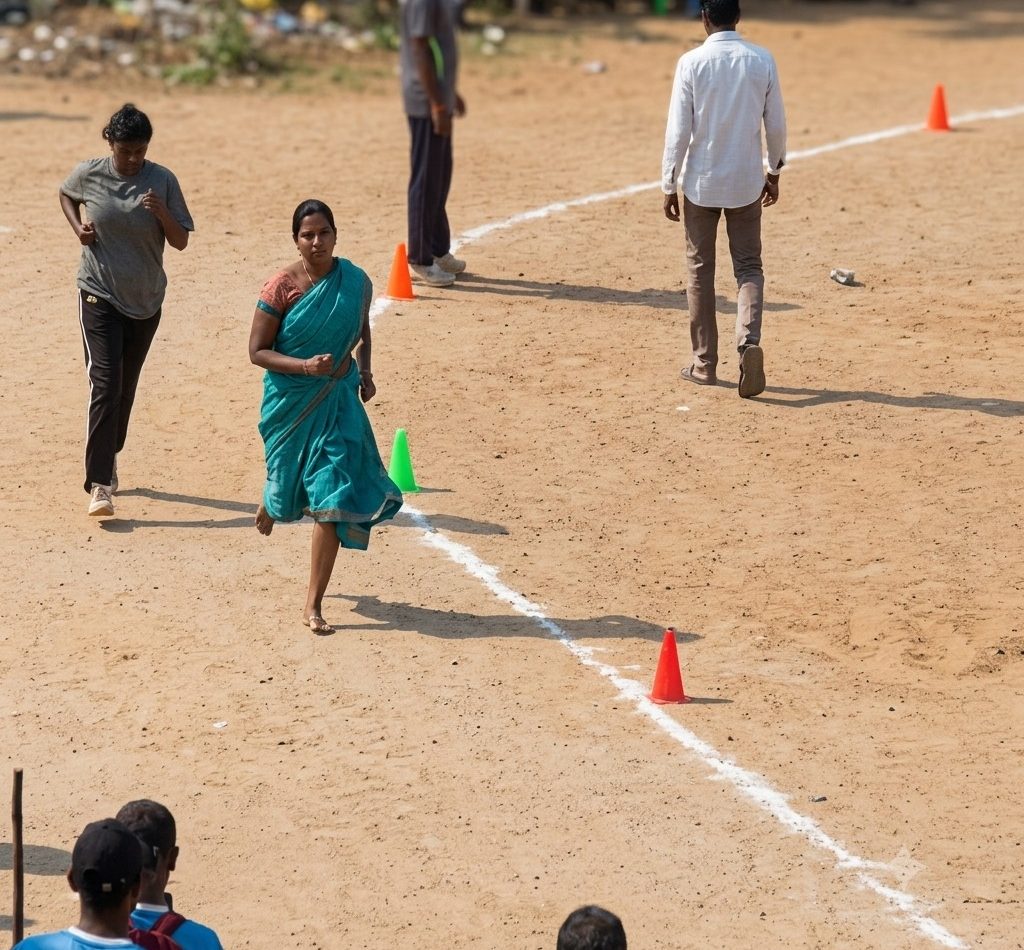
Ramgarh, Jharkhand: When other candidates arrived for a Home Guard recruitment trial in sports shoes and training clothes, Kavita Mahato ran 1,600 metres barefoot, wearing the saree she had arrived in.
The 28-year-old from Soso village in Ramgarh’s Dulmi block completed the distance in about seven minutes during a pre-trial held at the Sidho-Kanhu Maidan on October 4. A video of her run has since circulated widely on social media, drawing attention to the circumstances behind it.
For Kavita, however, the race was not simply about proving her physical fitness.
She is a widow, a mother of two and the person carrying the financial responsibilities of her household.
Her husband died about three years ago after an illness. His treatment left the family in debt, according to a report by Navbharat Times. Since his death, Kavita has been working as a labourer, including at a brick kiln, while caring for her children and elderly in-laws.
A government job, she says, could offer the family something she currently does not have: greater financial security.
She almost did not know how she would run
The conditions in which Kavita reached the trial were markedly different from those of many other candidates.
Speaking to Navbharat Times, she said she reached the ground without eating because she had to leave early. She noticed other candidates arriving with family members, food, fruit and water.
She also felt self-conscious about her clothes and broken footwear.
But there was no alternative arrangement available to her, so she ran barefoot in her saree.
What happened next turned her into the most talked-about candidate at the trial.
She completed the 1,600-metre course well inside the 10-minute time limit reported for the trial. Different reports have put her timing at around six to 6:45 minutes; the detailed account by Navbharat Times records it as approximately 6:45 minutes.
Behind the viral video is a much harder reality
The viral image is easy to understand: a woman in a saree, running barefoot under the sun.
The less visible part is what happens after she leaves the field.
Kavita still has to return to the work that pays for her family’s daily needs.
After losing her husband, she took on responsibilities that extend beyond raising her two children. Reports say she also looks after her in-laws while working as a labourer.
Her pursuit of the Home Guard position is therefore tied to something more fundamental than a uniform or a government designation.
It is an attempt to find a more stable livelihood.
A recruitment drive with reserved positions for women
The Ramgarh Home Guard recruitment drive involves 284 posts.
Reports say 50% of the positions are reserved for women, while around 5% are reserved for widowed and divorced women. The formal physical examination is scheduled from October 24 to November 5, 2026, and includes the 1,600-metre run along with other physical requirements.
For Kavita, therefore, the trial run was only one stage.
The final selection is still ahead.
Her viral run should not be confused with being selected for the Home Guard.
What the barefoot run really shows
It is tempting to describe Kavita’s story simply as one of determination.
But there is another story underneath it.
A woman who has lost her husband, works in a physically demanding job and supports a household is competing for one of the few forms of employment that could provide her with greater stability.
She did not arrive with the equipment associated with athletic preparation.
She arrived with what she had.
That distinction matters.
Stories like Kavita’s can easily become social-media inspiration: a photograph, a short video and a caption about “women’s power”.
But the more important question is what happens after the applause fades.
Will she get the opportunity she is competing for?
Will her performance be enough to move her from precarious daily-wage labour into secure employment?
And how many other women with comparable ability never reach the starting line because they cannot afford the time, transport, food, training or equipment required to compete?
Kavita’s run has already attracted attention because it makes inequality visible in a single frame.
But her story is not over.
The final Home Guard selection will determine whether that barefoot run becomes the beginning of a more secure chapter for her family — or simply another example of talent emerging from circumstances that gave it very little room to grow.
For now, Kavita is still running.
And the job she wants is still ahead.