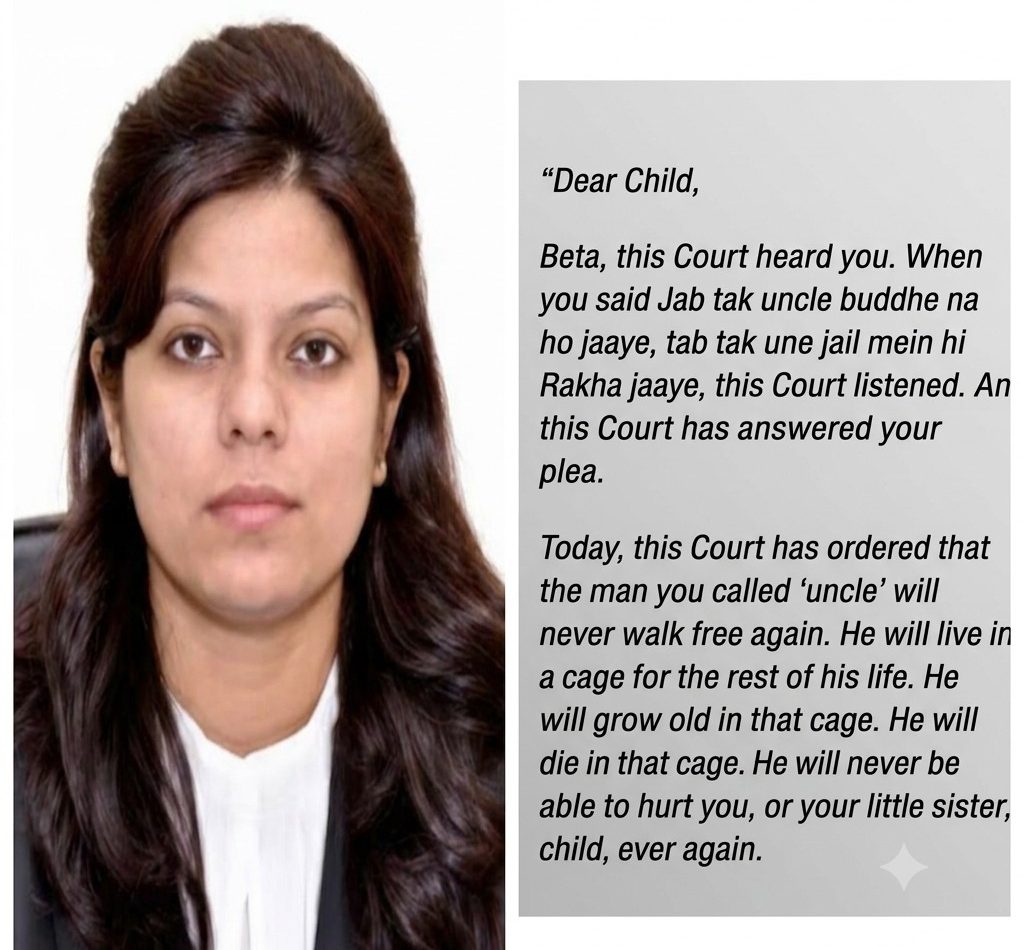
A Delhi judge told a 10-year-old rape survivor the convict would “grow old and die in that cage”. Delhi HC has ordered the message and ₹10.50 lakh compensation delivered to her.
A Delhi judge’s unusual personal message to a 10-year-old rape survivor — telling her that the man she called “uncle” would grow old and die in prison — has now been ordered by the Delhi High Court to be delivered to the child along with ₹10.50 lakh in compensation.
The message was written by Additional Sessions Judge Rajani Ranga of the Rohini court after convicting Sumit Shakya in a case under the Protection of Children from Sexual Offences (POCSO) Act.
The Delhi High Court, in an order passed on September 22, described the note as a message of encouragement and directed the North-West Delhi District Legal Services Authority (DLSA) to print it and hand it over to the survivor or her family within two weeks.
“This Court heard you”
The case dates back to July 23, 2023, when the girl was seven years old. She is now 10.
During the proceedings, the child had expressed a simple wish: that the man she referred to as “uncle” should remain in jail until he grew old.
Judge Ranga referred directly to that plea in the postscript attached to her sentencing order.
“Beta, this Court heard you,” the judge wrote, explaining that the child’s request had been heard and answered by the court.
The judge then told the child that the convicted man would not walk free again.
“He will live in a cage for the rest of his life. He will grow old in that cage. He will die in that cage,” the judge wrote.
She also assured the child that he would not be able to hurt her, her younger sister or another child again.
From a judgment to a message for a child
The judge deliberately moved away from the formal language normally used in a sentencing order to address the survivor directly.
She acknowledged the child’s courage in telling her mother what had happened, identifying the accused in court and speaking about the assault.
The judge also recognised the limit of what a criminal court can do.
“This Court cannot give you back your childhood,” she wrote, while assuring the child that her words had been heard and her plea had been granted.
The message ended by turning the child’s attention away from the courtroom and towards her life ahead.
“Now, beta, live your life. Go to school. Make friends. Laugh. Play. Dream,” the judge wrote, adding that the court would remember her courage.
Accused sentenced to life imprisonment
The trial court convicted Shakya of aggravated penetrative sexual assault of a child below 12 years under the POCSO Act and criminal intimidation.
He was sentenced to imprisonment for the remainder of his natural life. The court also imposed fines of ₹1 lakh for the POCSO offence and ₹20,000 for criminal intimidation, with the prison terms to run concurrently.
The trial court additionally awarded ₹10.50 lakh in compensation to the child survivor, considering the nature of the crime, the suffering caused and its potential long-term impact on her.
Delhi HC orders message and compensation to reach her
The case subsequently reached the Delhi High Court after Shakya challenged his conviction and sentence.
A Division Bench of Justice Prathiba M Singh and Justice Dinesh Bhatt directed the Secretary of the North-West Delhi DLSA to print the trial judge’s message and hand it over to the survivor or her family members along with the compensation.
The DLSA has been given two weeks to comply and has also been asked to submit a status report on the compensation.
The High Court also directed that notice of the appeal be served on the survivor through the investigating officer.
Life sentence not suspended at this stage
While hearing the appeal, the High Court considered the evidence on record, including forensic evidence, and declined to suspend the convict’s sentence at this stage.
The appeal itself remains pending.
The DLSA’s status report is scheduled to be considered on November 4, 2026, while the criminal appeal is listed for January 20, 2027.
The court’s latest intervention therefore has two distinct aspects: the legal proceedings against the convict continue through the appeal, while the court has separately ensured that the child receives the compensation awarded to her and the message written specifically for her.
A message beyond the courtroom
The unusual postscript has drawn attention because it speaks to the child not as a witness in a criminal case, but as a young person whose life continues after the judgment.
The judge’s words do not claim that a sentence can undo what happened. Instead, they acknowledge the child’s request, affirm that she was heard and encourage her to return to school, friendships, play and ordinary childhood experiences.
The Delhi High Court’s direction means those words will not remain only in a court record.
They are now to be physically delivered to the child along with the compensation awarded in her case.
For a 10-year-old who once asked the court to keep the man she called “uncle” in prison until he grew old, the judge’s response was unequivocal: the court heard her.