Teenage girls in England are campaigning to keep school uniforms out of pornography, raising questions about sexualisation, youth-coded imagery and UK law.
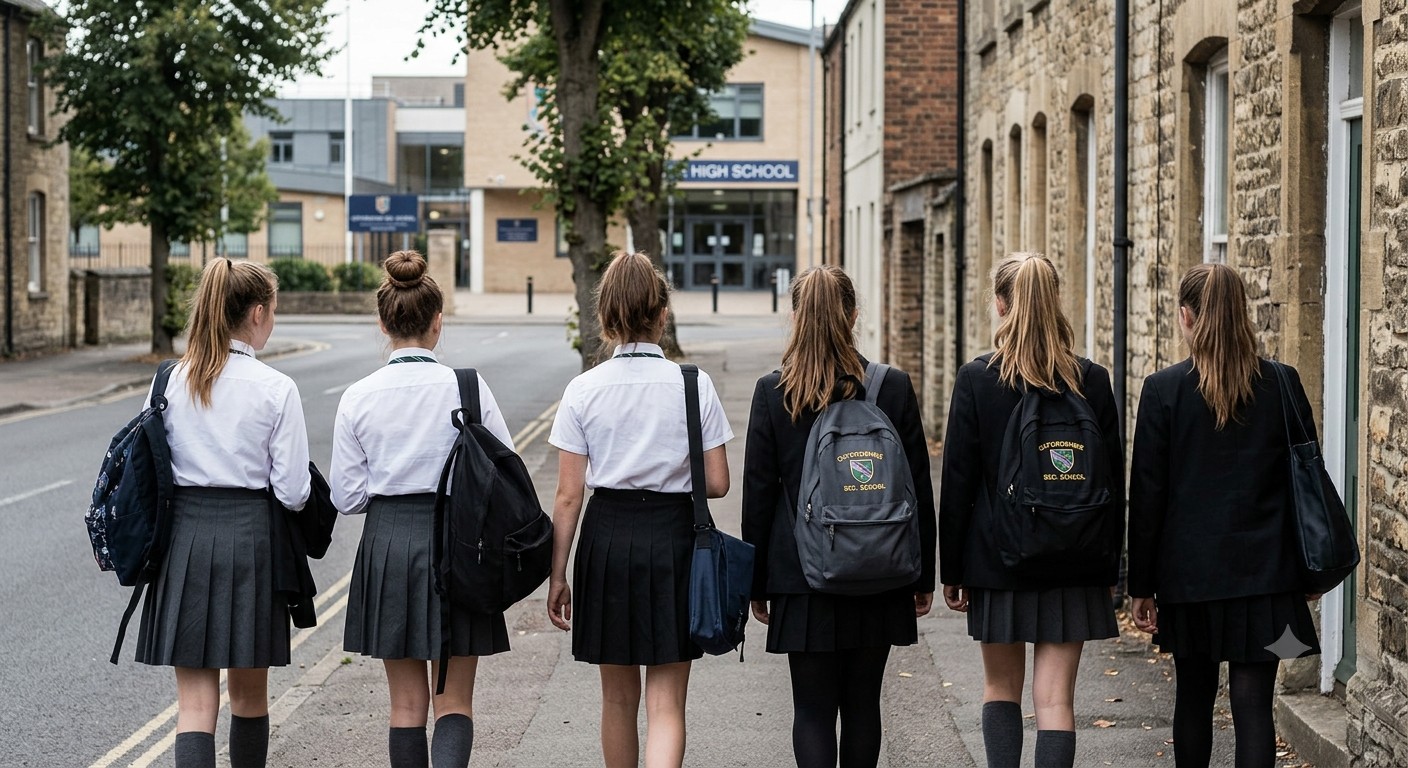
For teenage girls, a school uniform is not a costume. It is something they are required to wear to class, on the way to school and, in many cases, on the journey home.
Now, a group of schoolgirls in England is asking why that same symbol of school-age identity is being used in pornography.
Students from the Little Feminist Bookclub at The Cooper School in Bicester, Oxfordshire, have launched a petition calling for school uniforms to be banned from pornographic content. The petition, created on September 9, says the girls want to challenge what they see as the sexualisation of clothing associated with children and young people.
Their campaign has opened a wider conversation about where pornography regulation should draw the line when adult performers are presented through imagery associated with childhood.
It also raises a question that goes beyond pornography: what does it do to girls when an item they are required to wear every day is repeatedly used to create a sexualised image of a school-age identity?
‘It is what we have to wear’
The campaign has been driven by students themselves, with support from teacher Kristan O’Flynn and academics and campaigners working on pornography law.
The petition argues that school uniform in pornography can be used to evoke childhood and school-age identities. It calls on the UK Government to prohibit its use in pornographic content.
The concern is particularly personal for girls who actually wear school uniform.
The campaign has highlighted the discomfort some students experience when they leave school wearing clothing that they know is also used in sexualised imagery. One student, identified by The Times as 15-year-old Rose, said she had become uncomfortable wearing a skirt outside school because of how she feared it might be perceived.
That distinction matters.
The girls are not arguing that a school uniform is inherently sexual. They are questioning the decision to place an object associated with children into an adult sexual context.
What does research say?
There is research showing that youth-coded imagery and language appear in online pornography, including material involving school-related identities.
A 2021 study published in the British Journal of Criminology examined more than 150,000 titles appearing on the landing pages of three major pornography websites in the UK during a six-month period in 2017–18.
The researchers found that one in eight titles in their sample described sexual activity that met their criteria for sexual violence. Within the category the researchers classified as coercive and exploitative sexual activity, “schoolgirl” was among the most frequently occurring youth-related terms, alongside “girl” and “teen”.
But the findings need to be understood precisely.
The study analysed pornography titles and the sexual scripts they presented. It did not establish that school uniforms themselves cause sexual violence. Nor does the presence of a school uniform in pornography establish that an actual child was involved.
That distinction is important when discussing the issue publicly.
The girls’ campaign is based partly on the argument that the uniform itself can function as a visual shorthand for youth. The research provides evidence about the broader presence of youth-coded themes in pornography, but it cannot by itself prove every claim made by campaigners.
The girls are also talking about real-world harassment
The campaign draws attention to a separate but related issue: girls being sexualised or harassed while wearing their actual school uniforms.
A 2018 survey by Plan International UK of more than 1,000 girls and young women aged 14 to 21 found that 35% had experienced unwanted sexual attention while wearing school uniform. Eight per cent said they had been filmed by a stranger without their consent while wearing it.
Those figures concern real-world experiences of harassment, not pornography.
But they help explain why the campaign resonates with some young people.
A girl who has experienced unwanted attention while wearing her school uniform may understandably view the sexualisation of that same clothing in pornography differently from an adult who sees it simply as a costume.
The problem, however, is not the uniform itself.
A school skirt does not cause harassment. A tie does not invite sexual attention. And a child wearing a uniform does not become responsible for the way an adult chooses to perceive her.
Britain already has laws dealing with simulated young people
The campaign is also taking place against changes to Britain’s pornography laws.
The Crime and Policing Act 2026 contains provisions concerning pornographic images depicting sexual activity involving someone who is, or is pretending to be, under 16. The legislation therefore deals not only with the actual age of a performer but, in specified circumstances, with the portrayal of someone as under 16.
That is relevant to the campaign because the students argue that a school uniform can be used to create precisely that association with childhood or school-age identity.
But it would be inaccurate to say that British law simply bans every pornographic image involving a school uniform.
The legal question is more specific, and the campaign is asking lawmakers to go further.
This is not the first time British students have raised the issue
The Bicester campaign follows an earlier effort by students at Sandbach High School and Sixth Form College in Cheshire.
In 2022, students launched a parliamentary petition calling for school uniforms to be prohibited in sex shops and pornography. That petition received more than 16,000 signatures but did not reach the 100,000-signature threshold associated with consideration for a parliamentary debate.
The renewed campaign therefore reflects a question that has already been raised by British school students: whether adult sexual content should be permitted to use imagery that deliberately draws on the visual identity of children.
But would banning the uniform solve the problem?
This is where the debate becomes more complicated.
Removing school uniforms from pornography would not, by itself, prevent the sexualisation of girls.
It would not stop harassment in public spaces.
It would not prevent strangers from filming schoolchildren.
It would not address every form of pornography involving youth-coded imagery.
And it would not change the behaviour of adults who sexualise children.
The campaign is therefore best understood as a demand for a particular regulatory change within a much larger debate about pornography, sexualisation and the protection of young people.
There is also a practical question for lawmakers: how would such a prohibition be defined and enforced?
Would it cover only an actual school uniform? What about a costume designed to resemble one? Would it cover other visual cues associated with school-age children? And how would regulators distinguish between an adult performer wearing ordinary clothing and material deliberately intended to portray someone as a child?
Those questions would need clear answers before any new prohibition could be effectively enforced.
Why the campaign matters even beyond the proposed ban
The most striking part of the story may not be the proposed law itself.
It is that teenagers are having to raise the question in the first place.
School uniforms are supposed to identify students as members of an educational community. The Cooper School itself describes its uniform as promoting belonging, equality and safety.
For the students campaigning against its use in pornography, that meaning becomes uncomfortable when the same visual symbol is used in an entirely different context.
They are effectively asking adults to confront a contradiction:
If society tells girls that a school uniform represents childhood, education and safety, why should the same symbol be available to create a sexualised image of youth?
There may be disagreement over whether a complete ban is the right legal response.
But the girls’ underlying concern is harder to dismiss: children should not have to take responsibility for how adults sexualise symbols of childhood.
The uniform is not the problem.
The question is what adults choose to make it mean.