Harsimrat Kaur Badal’s call for a Kisan Andolan-style women’s mobilisation puts mothers and women at the centre of Punjab’s drug debate — but also raises a bigger question about who supports women when addiction enters their homes and communities.
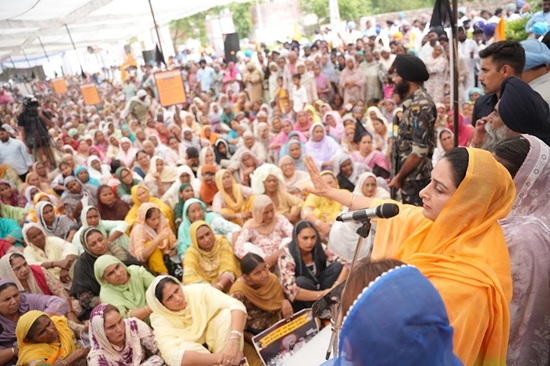
Mohali (Punjab), September 26, 2026: Punjab’s drug crisis is usually discussed through the language of young men, drug traffickers, police action and political promises. But at a gathering of women in Mohali on Saturday, Shiromani Akali Dal leader and Bathinda MP Harsimrat Kaur Badal put women at the centre of the response.
Addressing the SAD women’s wing’s ‘Maawan-Dheeyan Insaaf’ campaign, Badal called on women across Punjab to launch a movement on the lines of the Kisan Andolan and organise ‘thikri pehra’ in villages to prevent the sale of drugs.
“This is the time to take things into our own hands if we want to save our sons and the coming generation,” Badal said.
Her appeal was political. But it also touches a much larger reality: when addiction enters a family, women often end up dealing with its consequences inside the home.
A son struggling with substance use does not face the problem alone. His mother may become his primary caregiver. A wife may have to manage a household when her husband is unable to work.
Families can face financial strain, conflict and social stigma, while women may take on additional unpaid care responsibilities.
Yet these women rarely appear at the centre of Punjab’s drug-policy conversation.
From protecting families to policing villages
Badal’s suggestion of thikri pehra effectively asks communities to become another layer of vigilance against drug sales.
That raises an important question: how much responsibility can women and communities realistically be expected to take for a problem that also requires policing, treatment, rehabilitation and public-health interventions?
Women can play an important role in identifying problems early, supporting children and demanding accountability from authorities.
But asking women to monitor villages does not by itself address the networks that supply drugs, the demand for substances or the need for accessible treatment.
Nor does it answer what happens when women themselves become vulnerable while confronting drug-related activity in their communities.
A mother standing up against drug sellers may be acting to protect her family, but she should not be expected to replace the police, health system or rehabilitation services.
The woman behind the “son” being saved
Badal repeatedly framed the issue around saving Punjab’s sons and the next generation.
That language reflects how the drug crisis is commonly understood in Punjab — as a threat to young men.
But women can experience the crisis in different ways.
They may live with a husband or son who is dependent on substances. They may become responsible for arranging treatment or managing household finances. They may face violence or intimidation within families affected by substance use. They may also experience the stigma attached to addiction without having caused it.
And women who use drugs themselves can face an additional layer of stigma, often making it harder to seek help.
A response that puts women at the centre therefore needs to ask more than whether mothers can help keep drugs away from their sons.
It needs to ask whether women have access to treatment, counselling, financial support, safe reporting mechanisms and protection from violence and retaliation.
What happens after the rally?
Badal accused the Aam Aadmi Party government of failing to curb drug trafficking and questioned Chief Minister Bhagwant Mann over promises to act against drug traffickers.
She also alleged that drugs remained easily available in the state and criticised the government over what she described as inadequate action against major traffickers.
These are political allegations made by Badal and are not independently established by her statement.
She said the SAD, if voted to power, would introduce tougher measures against drug traffickers, including restricting bail for eight years and providing for life imprisonment, according to her proposal.
But punishment is only one part of the drug debate.
For women living with addiction in their families, the more immediate questions can be very different: Where can they get help? Who pays for treatment? What happens when rehabilitation fails? Who helps them deal with violence or financial insecurity? And what support is available to the caregiver?
These questions rarely receive the same political attention as arrests and seizures.
Women are not just a mobilisation force
The ‘Maawan-Dheeyan Insaaf’ campaign has placed women’s rights, safety and welfare at the centre of SAD’s political outreach.
The Mohali rally brought the drug crisis into that conversation.
Badal also raised other political issues, including the Enforcement Directorate’s investigation into alleged irregularities involving the Greater Mohali Area Development Authority and the AAP government’s promise of ₹1,000 per month for women.
But beneath the political contest is a question worth asking regardless of party:
If women are expected to protect Punjab’s communities from drugs, who is responsible for protecting the women?
Women can organise. They can demand accountability. They can speak out when drugs enter their neighbourhoods. They can support children and family members seeking recovery.
But none of that should mean transferring the responsibility for a public crisis from institutions to women standing outside their homes.
Punjab’s women may be ready to fight the drug crisis.
The bigger test is whether the state is ready to stand behind them.