
Health
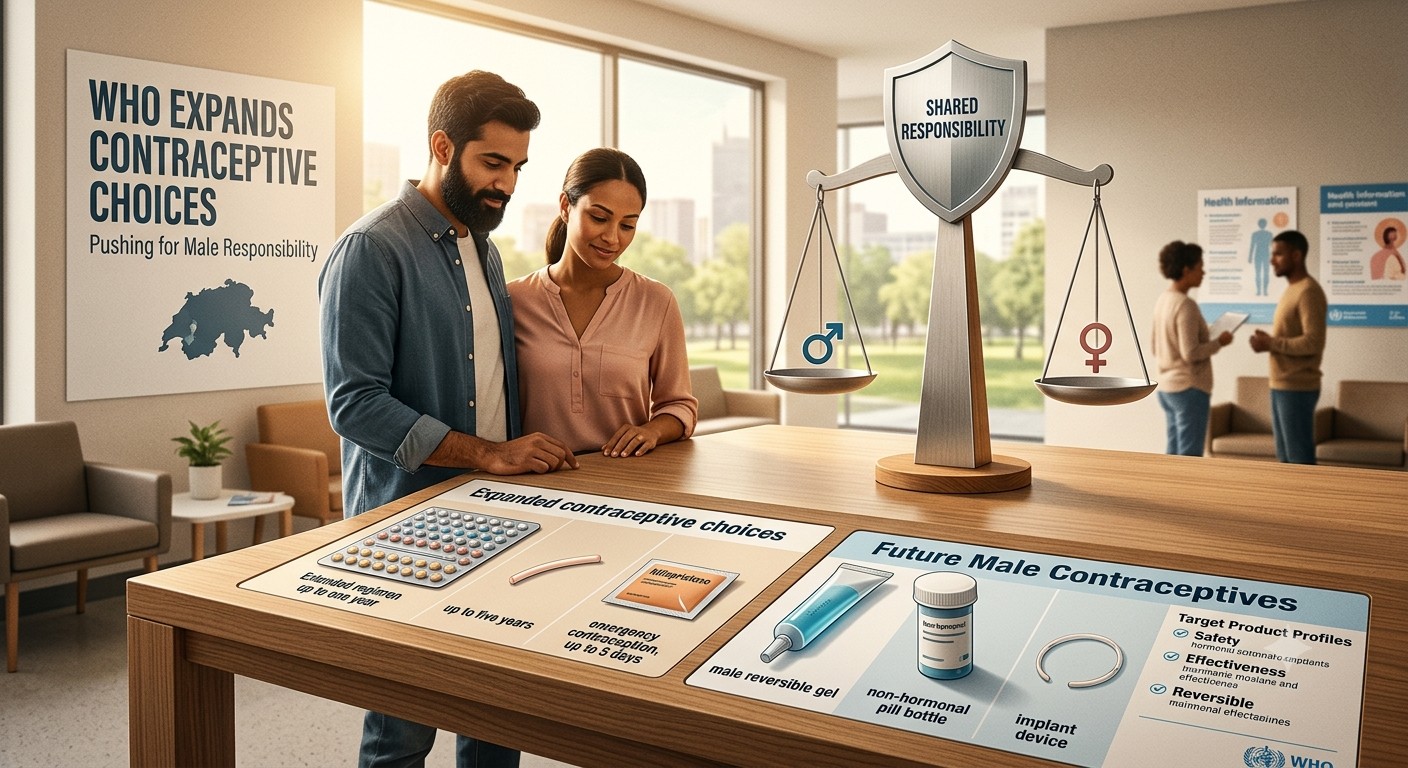
Geneva (Switzerland), September 25, 2026: Contraception has long been discussed as something women have to manage — remembering pills, dealing with side effects, visiting clinics, getting implants replaced and, in many cases, carrying much of the responsibility for preventing an unintended pregnancy.
The World Health Organization (WHO) is now calling for a wider range of contraceptive choices, while also pushing research that could give men more options to take responsibility for contraception.
In new guidance released this week, WHO recommends expanding how some existing contraceptive methods are used and adding another emergency contraception option. At the same time, it has published its first Target Product Profiles for novel male contraceptives, setting out what future male birth-control methods should aim to achieve in terms of safety, effectiveness, reversibility, acceptability and affordability.
The move comes as an estimated 164 million women who want to delay or avoid pregnancy are not currently using contraception, according to WHO.
The organisation says expanding contraceptive options can give people greater control over whether to use contraception, which method to choose, and when to change or stop it.
One of the new recommendations concerns combined oral contraceptive pills.
WHO says these pills can be taken in extended regimens for up to six months, or continuously for up to one year, as alternatives to traditional cyclical use.
WHO also supports the use of etonogestrel-releasing contraceptive implants for up to five years, potentially reducing the number of replacement procedures, clinic visits and associated costs.
The guidance also recommends mifepristone as an additional emergency contraception option, to be taken as soon as possible and within five days after unprotected sex. WHO says available evidence indicates that mifepristone at doses of 10–50 mg is likely to be as safe and effective as other emergency contraceptive methods.
These are not necessarily new contraceptive technologies. Rather, WHO’s new guideline is partly about expanding how existing methods can be used and which options can be included in national family-planning programmes.
The guidance also makes clear that not every proposed contraceptive has enough evidence yet. WHO is calling for more research on ormeloxifene before it is included in family-planning programmes, citing limited safety evidence. It recommends against adding quinestrol-containing contraceptive pills to national programmes because of limited evidence and reports of serious adverse events.
Today, men have relatively few contraceptive methods under their control: principally condoms, withdrawal and vasectomy.
WHO says around 30% of couples rely on a male method, despite this relatively limited choice.
For years, one assumption has been that men would not be interested in using new forms of contraception.
New research cited by WHO challenges that assumption.
More than 75% of couples surveyed said they would be willing to use a new male contraceptive, while more than 85% of women said they would trust their male partners to take responsibility for contraception. The global study involved couples in four low- and middle-income countries.
WHO has now developed its first Target Product Profiles for novel male contraceptives to give researchers, funders and developers clearer standards for what future products should look like.
Several hormonal and non-hormonal approaches are being investigated, including methods designed to suppress sperm production, interfere with sperm function or block sperm transport. WHO says several candidates are already in advanced clinical trials and that reversible male contraceptives could potentially reach the market within the next five to 10 years.
The significance of this development goes beyond adding another method to a family-planning chart.
It raises a question that has often been missing from everyday conversations about contraception:
Why should preventing pregnancy be primarily a woman’s responsibility?
Women currently have far more contraceptive options than men, but having more options can also mean carrying more of the practical burden — from remembering daily pills to managing side effects or undergoing procedures.
Male contraception would not eliminate the need for women to have their own choices. Nor would it mean that every man should use a male method.
What it could do is create more genuine shared responsibility.
That distinction matters because contraception is not only about avoiding pregnancy. It is also about who gets to make decisions about fertility, whose body bears the medical burden and whether couples have meaningful choices when deciding how to prevent an unintended pregnancy.
WHO’s latest guidance puts that question back into the conversation — this time alongside actual investment in developing more options for men.
And perhaps the most revealing finding is that the demand may already be there.
The question is whether research, healthcare systems and the contraceptive market will catch up.